Peregrine Piper’s Grandfather Clock by Michael Rutt
[This article first appeared in the Bedfordshire Magazine in Autumn 1970. We are very grateful to Mr Rutt for permission to reproduce it, slightly updated, here.]
Peregrine Piper bought his grandfather clock from George Pepper, the Biggleswade clockmaker, about the time of the battle of Waterloo. He was a Norfolk man who had moved from Stonefield in that county to Henlow before 1808. Described as a victualler in that year, he borrowed money from Thomas Paternoster, the Hitchin bookseller, to buy land in Langford. The money was used to buy Scrup’s Field which contained ten acres of land. This field today is occupied by Garfield Farm, a disused gravel pit and houses facing onto Church Street [Since developed as a new housing estate]. Until just after World War II it was part of a recreation ground. Peregrine lived in a cottage in the corner of this field at the junction of Water Lane (now Church Street) and Back Lane (now Station Road).
Peregrine’s name appears for the first time in the Land Tax returns in 1808, and in 1810 he was paying thirteen shillings on Scrup’s field and five shillings on the Midsummer Meadow in Cow Common, land which was near the river at the southern boundary of the parish adjoining Henlow. The name Scrups perpetuates the name of a medieval holder of the Manor of Holme with Langford. In 1398 Richard le Scrope granted land in Langford to the Abbey and Convent of Westminster and the Dean and Chapter of Westminster were later lords of the manor. Scroup’s Farm at Holme in the parish of Biggleswade still bears the name of the medieval holder of the manor. Peregrine added to his land in 1819 by a purchase of another part of Scrup’s field from Edward Lindsell of Biggleswade, from whom he also rented land.
Until 1829 the village of Langford was open fields except for the land immediately within the settlement area. Enclosure in the latter area had taken place during Tudor and early Stuart times, since in 1619 an inventory of the property of Joan Underwood, a widow of Langford, taken on 26 April in that year, states, ‘for half the grane growing in a cloase called Scraps, £8’. A retired market gardener in Langford told the present writer that in 1967 he noticed barley growing in the part of Scrups field which is still arable for the first time since his childhood days in the 1890s. Under modern farming techniques the cereal crops are grown on the heavier boulder clay soils in the east of the parish.
The prosperity and public standing of Peregrine Piper increased throughout the decade of Waterloo and the reign of George IV. He was a juryman in 1820, a Land Tax assessor for Langford in 1822 and an assistant to the Commissioners for Inclosure in 1827. He died in June 1829 at the age of 65. His will together with a codicil to it was proved by his eldest son, Edmund Piper, at Bedford on 27 June, 1829. The sum of the estate was below £450. Peregrine’s original instructions to his executors were to sell all his land and his house, the proceeds to be divided between his five children. The codicil instructed them to allow his widow, Hannah Piper, ‘so long as she remains my widow’, to retain the property and on her death it was to pass to his sons and daughters. The elder daughter, Elizabeth Isherwood, was singled out in the will to ensure that her heirs and successors inherited their share of money and land. The family link with Norfolk was not broken since a cottage and an acre and a half of land in Stonefield, in which Peregrine had a half-share was bequeathed to his second son William. The latter was still farming Scrup’s field at the time of his death in 1874.
The fact that Elizabeth Isherwood was specially cared for in her father’s will was because she had been widowed whilst still young and had a family of small children. Although she later married again, her son Robert was taken care of and brought up by his uncle Edmund who had no children of his own. Elizabeth lived at Southill with her second husband who was a cabinet maker by trade. Her last descendant died at Hitchin about 1960. Edmund Piper and Robert Isherwood went into partnership as farmers in Langford and by 1875 they were working some 100 acres of land. Edmund had the consolation of seeing his nephew attain prosperity in his declining years. Oral tradition has it that he went very deaf in later life and that the Vicar, Rev Christopher Ewbank, would ask him, as he leaned on the front gate of Tithe Farm on summer Sunday evenings, to come to church. The answer was that he was too old and too deaf to hear the sermon. In the present writer’s family he is still referred to as ‘Uncle Piper’, surely a relic of the Victorian manner in which aunts and uncles were called by their surname. Much of the land farmed by the firm of Piper and Isherwood was rented from the estate of the Welby family and when this estate was sold in 1875 after the death of the Rev Montague E Welby, they purchased Tithe Farm and the field called Bury Garden which was attached to it.
Mrs Margaret Rutt
Langford in the nineteenth century was a village without a squire, but in one sense it was a closed village since much of the land was owned by an absentee landlord. The Welby estate consisted of 662 acres of arable and pasture land.
They were a Lincolnshire family and the last landlord of their Langford lands was the third son, by his second marriage, of Sir William Welby, who had been created a baronet in 1801. They had bought the estate from Sir John Fagg in the late eighteenth century. When the estate was sold Langford became an ‘open’ village in a sociological sense because the yeoman farmers acquired the land and became the influential figures in the parish which had no squire and only minor gentry and the Vicar to represent a different and higher class.
Closed villages tended to have a smaller population of about 250 people. In the last two decades of the nineteenth century the population of Langford rose to over a thousand, after it had become an open village. This compares with, for example, Southill and Old Warden, which have remained small to this day because of the presence of a major landlord owning all or most of the village. Edmund Piper was a typical yeoman farmer, taking part in village affairs, in common with many other such farmers who had bought land from the Welby estate, and from other landlords when the manorial system of landholding broke up, and after the enclosure of the common fields.
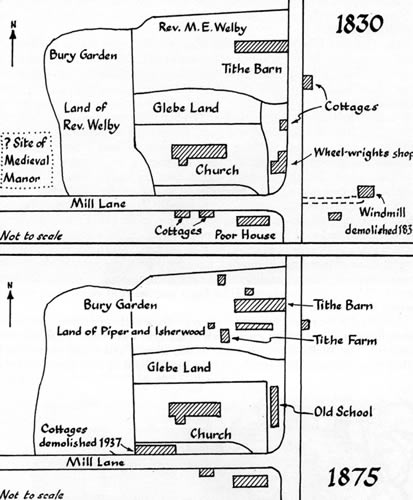
The Welby estate was sold by auction at the Swan Hotel, Biggleswade, in December 1875 under the gavel of Mr Calthorp.
The catalogue described the land as ‘being in high condition, great part of it from the nature of the soil is specially adapted, like the adjacent Biggleswade market garden land, for garden produce, and the contemplated Langford Siding on the railway, for which land has been purchased by the Company, will give great facility for procuring manure and delivering produce’.
It went on to say that there was reason to believe coprolites existed under part of the land, ‘the geological formation of which is similar to that in which they are worked to a large extent in the immediate neighbourhood’. This is a reference to the coprolite workings at Sandy and Potton which were of considerable importance for use as fertiliser at this time.
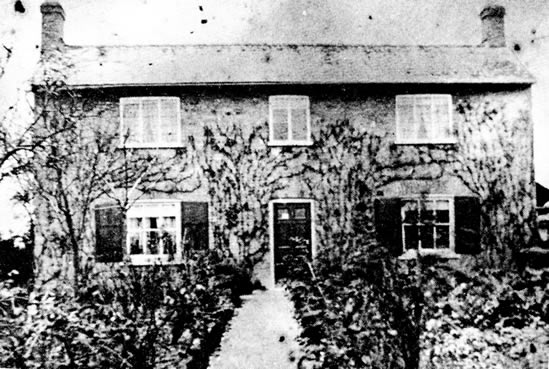
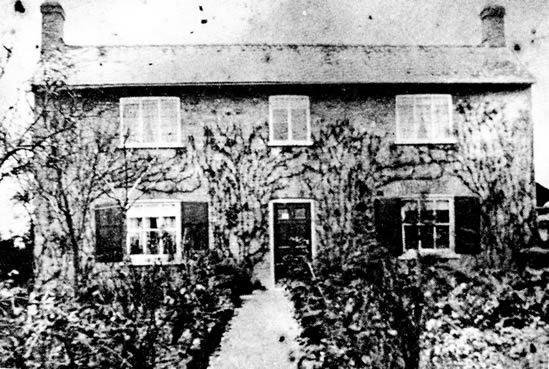
Edmund Piper and Robert Isherwood thus acquired the farm of which they were already tenants. This consisted of the farm house [see illustration], the Tithe Barn, which stood almost at right-angles to the road, another range of barns (blown down in a gale in the 1930s), a fourstand cow-house, a fourstand stable, waggon hovels, a chaffhouse and a nag stable.
They also rented the Glebe land between Tithe Farm and the churchyard. This piece of Glebe was probably part of the original endowment of the church to the Knights Templars in 1144. A vicarage house stood next to it until the seventeenth century. At the Archdeacon’s visitation in 1707 it was stated that there was no vicarage house, ‘the land where it stood having been laid to a churchyard’.

A Glebe terrier of 1605 describes this vicarage with a full range of barns and the Parsonage Barn, now Edmund Piper’s Tithe Barn. In 1749 the incumbent had leased the Tithe Barn to Thomas Ashby of Holme Mill and Anthony Thody of Langford. Their first lease was for twelve years at a rental of £120.
They were to keep it in good repair with ‘principle {sic} timbers, lime lath and nails’. They also rented the Glebe. The lease was renewed for a further seven years in 1761. For their money they collected the tithes of corn, grain and hay, which were ‘to be laid on the premises’.
Edmund Piper lived until 1882. He was the same age as the century. The present writer was the youngest child in Langford at the time of the Silver Jubilee of George V and received a commemorative mug. The oldest inhabitant at that time was Mr Jesse Street, ninety-four years old. Mr Street, as a younger man, had worked for ‘Teddy’ Piper at Tithe Farm. Edmund’s sole heir was his nephew Robert Isherwood and he, for a further thirteen years, farmed the land with his son Frederick Isherwood. Robert died in 1895, a month after his son had married Elizabeth Hart of Kempston, who had come to Langford as a school teacher, a year or so previously.
The land at the rear of Tithe Farm is known as the Bury Garden. The fact that it is called ‘Bury’ points to its having a connection with a large house. In 1951 the meadow land near the Mill and at the west side of Bury Garden was levelled to convert it to arable use. When this levelling was done a site was unearthed which appeared to be the remains of a house.
Unfortunately this was not recorded at the time. In the writer’s opinion this was the site of the hall or house of the Manor of Langford Rectory which was held for many-centuries by The Knights Templar. There was an oral tradition of a house near Bury Garden and drains leading to the site were known on the field. Its position close to the church also fits into this theory. In 1185 the Templars had income from the curia fratrum, the hall or house of the brothers; and the fructum gardini, the fruits of the garden.
Frederick Isherwood was a well-liked and respected figure in Langford. At various times he held the offices of churchwarden, parish clerk, assistant overseer and rate collector. He continued the family farming business begun by his great grandfather Peregrine Piper. He bought the piece of Glebe land adjoining Tithe Farm when the living of Langford was augmented after World War I.
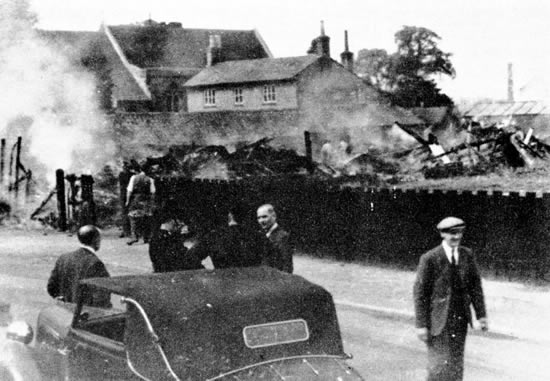
Mr Isherwood died in 1927 and the old Tithe Barn was burned down in a disastrous fire on I2 May, 1945. This was not the first fire near the church. On the site of the old school (now the Church hall) was a wheelwright’s shop owned by Edward Smith which burned down in 1864. The site cleared by this fire enabled the land to be purchased for the building of the school.
Before it was replaced by the Church Hall it was used as a dining room for the newer school on the opposite side of the road.
The century and a half since Peregrine Piper began farming in Langford has seen a complete change in land tenure and agricultural techniques. The ‘procuring of manure’ is no longer necessary when artificial fertilisers and chemical sprays are responsible for the brussels sprouts, barley and market garden produce for which this part of East Bedfordshire is so well known. This was the period, from 1870 to 1945, when very few farmhouses were built in the English countryside: a time when the English farmer felt the competition of imported food in refrigerated ships from the other side of the world. A period of two agricultural depressions when marginal land went out of cultivation and land which was arable became pasture.
Peregrine Piper’s grandfather clock now stands in a small modern bungalow in Langford and keeps excellent time. His Bible, dictionary, barometer and pewter candle snuffers are in the same bungalow. Maybe old Peregrine would turn in his grave in Langford churchyard to see the village today but at least he could still tell the time from his clock.
The photographs which illustrate this article were kindly loaned by Mrs Margaret Rutt.