A Postcard from the Front, 1918
Thompson Postcard 1918
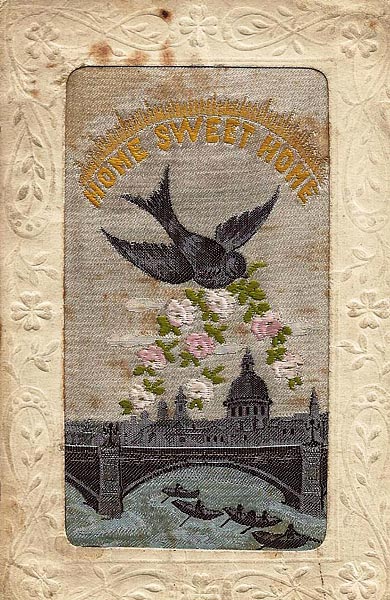
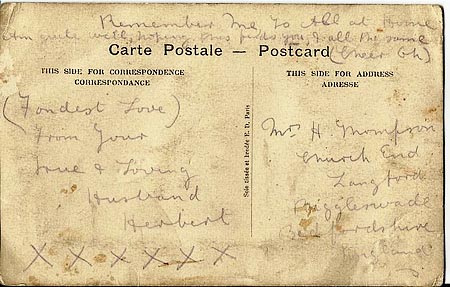
‘Remember me to all at Home. Am quite well, hoping this finds you, & all, the same (Cheeri-oh)
(Fondest Love) from your true and loving husband Herbert.
XXXXXX’
Addressed to:
Mrs H Thompson, Church End, Langford, Biggleswade, Bedfordshire, England
This card was found in Linda Franklin’s mother’s effects after she died in 2011. Linda says:
‘She used to show it to me from time to time and tell me to keep it, and some others she had kept, as they were very precious.Herbert Charles Thompson who sent the card was my Grandad and he was the village bootmaker.
He served in France as a driver with the Royal Field Artillery and was awarded the Military Medal for bravery in the field while saving the guns and returning to help other soldiers under fire. He had his horse shot from under him and he kept the shrapnel that went into the horse’s neck and I remember him showing it to me.’

Herbert’s Military Medal was the last awarded for gallantry in the opening phase of the Kaiser’s battle in May 1918:
Herbert Thompson was born at Scrupps Farm, Langford Road, Biggleswade, in 1894. His father was Fred Thompson who had a shoe shop in Hitchin Street, Biggleswade, and was also a market gardener. His mother was Laura Thompson and their children were Herbert, Percy and Fred Junior. At the 1911 census the boys were all living on the farm – Herbert was 17, Percy 15 and Fred 4. Herbert was working for his father, shoe-mending and Percy worked at an ironmongers. Both older boys went on to serve in France. Herbert joined the Army on 31 October1916 when he was 22 years and 8 months.
Just over a year before he married Olive Annie Roberts in St Andrew’s church, Langford, on her birthday: 23 October1915. Herbert was then stationed in East Sussex before being sent to France. Olive moved there with him as they now had a baby girl, Marjorie May, born in May 1916. Sadly, Marjorie died at 10months and he was allowed compassionate leave to be with his wife but then he had to go to fight in France.
‘Driver Herbert Thompson won the Military Medal, together with five other drivers in an extraordinary example of dedication and daring. As the Germans were advancing, a section of the Royal Field Artillery found itself under attack and for a while it looked as if their guns would be captured by the enemy. Driver Thompson and his comrades were having none of this and they galloped to the rescue, bringing back both the guns and two wounded gunners as shells exploded all around them.’
Biggleswade and the Great War: Our Own Flesh and Blood, by Kenneth Wood, p 124.
His award was reported in the Biggleswade Chronicle on Friday, 14 June 1918:
‘We learn with pleasure that the Military Medal has been awarded to Driver Herbert Thompson, of the Royal Field Artillery, for bravery in the field. He is the eldest son of Mr Fred Thompson, bootmaker, etc., and is widely known and prior to the war he was a very prominent member of the Thursday Football Club. He has served on the Western Front for some 14 months and has been in many grim struggles. The Military Medal has been awarded to Driver Thompson and five other drivers for bringing back to a place of safety two of the guns during the great German offensive.
The guns were nearly two miles away and a big bombardment was in progress when the drivers set out but they succeeded, despite German gas shells, in bringing back the guns although several of the horses and men were wounded. They also brought with them two gunners who had been wounded. Driver Thompson has sent home to his father a piece of shrapnel that was extracted from his horse’s neck.’
Herbert left the army on 28 April 1919 and bought the white cottage in Langford which was then 73 Church Street and he opened a boot and shoe repair shop in the shed next to the house. They had a son Teddy Thompson in 1919 and then Gwendoline Thompson (Linda’s mother) in 1929 and lived at the cottage until Herbert’s death on 1 November 1966. Olive then moved to a little cottage opposite the Shopping Basket store until she died in 1982. Herbert was known as one of the Iron Backs in the Biggleswade Thursday football team.
Below is a photo of his house in Church Street where he had his shoe repair shop. He is standing at the gate with his daughter Gwen Thompson and her friend Pamela Brown.
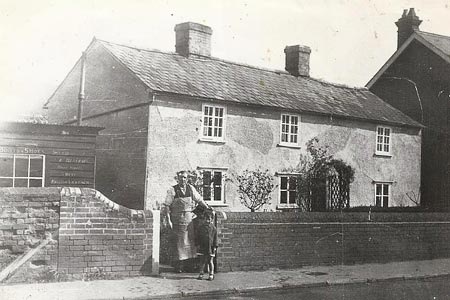
Ralph Turner in Langford: A Village Walk says
Later, part of the house was converted into his shoe repair shop instead of his working in the shed at the side where he had his big machinery where he polished the leather. Leather was soaked in tin baths on the floor.Linda remembersthat he always had tacks in his mouth while cutting the leather to the shape of the sole. During the Second World War he repaired boots for the soldiers who were stationed at the Church’s ‘old tin room’ opposite the house.Herbert’s cottage is still there, but has been much modernised.
‘Next we come to Crispin Cottage, this was the home of Herbert Thompson, the cobbler. Herbert had his cobbler’s shed in the garden just north of the cottage and boys used to visit him to get studs in their boots to slide with, and in return they had to deliver repaired boots and shoes to all parts of the village.
In severe winter weather lots of folks used to go over the common skating on the cow pond; one of these was Herbert. It is said he always seemed to skate with his bowler hat on and his scarf blowing behind him. For many years his wooden skates with steel runners were hanging up in his cobbler’s shop.’

The Military Medal (MM) was (until 1993) a military decoration awarded to personnel of the British Army and other services, and formerly also to personnel of other Commonwealth countries, below commissioned rank, for bravery in battle on land.
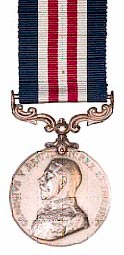 The medal was established on 25 March 1916. It was the equivalent for other ranksof theMilitary Cross (MC), which was awarded to commissioned officers and, rarely, to warrant officers, although WOs could also be awarded the MM. The MM ranked below the Distinguished Conduct Medal (DCM), which was also awarded to non-commissioned members of the Army.
Recipients of the Military Medal are entitled to use the letters ‘MM’ after their name. Over 115,000 awards were made for actions during the First World War. Additionally, over 5,700 bars were awarded, as well as 180 second bars.
There was one instance of a third bar being awarded; this was made to Private Ernest Albert Corey, who served as a stretcher bearer in the Australian 55th Infantry Battalion, which served on the Western Front.
During the Second World War, over 15,000 awards of the MM were made. The decoration has occasionally been bestowed upon non-British or Commonwealth subjects, and has also been awarded to some civilians.
In 1993, the Military Medal was discontinued. Since then the Military Cross has been awarded to personnel of all ranks within the British honours system.