A bridge too far . . .
On Tuesday 11 February 1873, a steam-ploughing engine pulling a threshing machine owned by T B Kitchener & Co departed from Mr Fowler’s farm in Langford headed for John King’s farm in Broom. Rather than going through their home town of Biggleswade, the team (David Larman and Walter Bonas, with a lad named Yerrall), took the minor road that passes Holme Mill (now often referred to as ‘Jordans’). As can be seen from the Ordnance Survey mapping at Figure 1, this shorter route involves four bridges – the first crossing a small brook; the second, the channel of the River Ivel serving the mill (beside the bypass weir); the road then bending sharply to cross the Ivel Navigation channel (next to the lock) on a third bridge; with the fourth (known as ‘Broom Bridge’) traversing another small channel of the Ivel at ‘Rook’s Hole’ a short distance before Broom Grange.

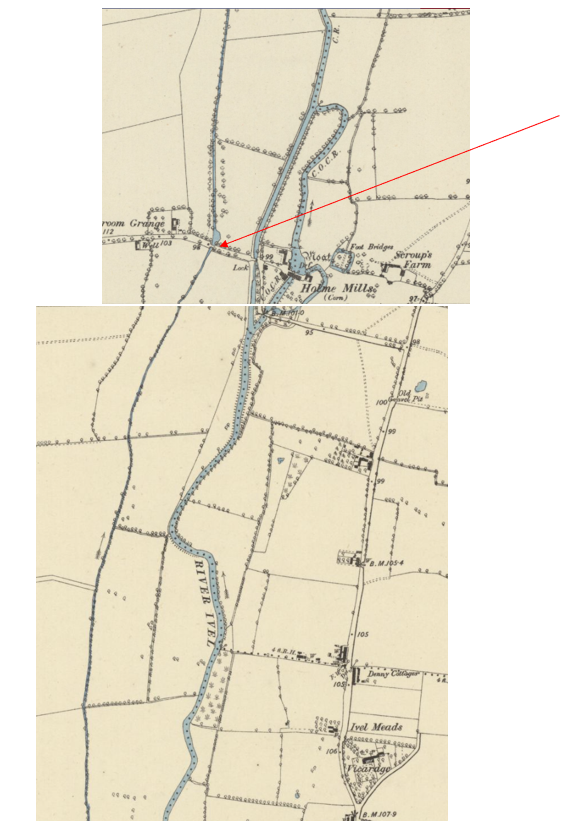
Figure 1: Ordnance Survey map extracts showing location. (Source: National Library of Scotland.)
But, just after 2.30pm, disaster struck when both the steam plough and threshing machine dropped from this last bridge into the stream, upending to stand side by side, as Plates 1–3, below, show.
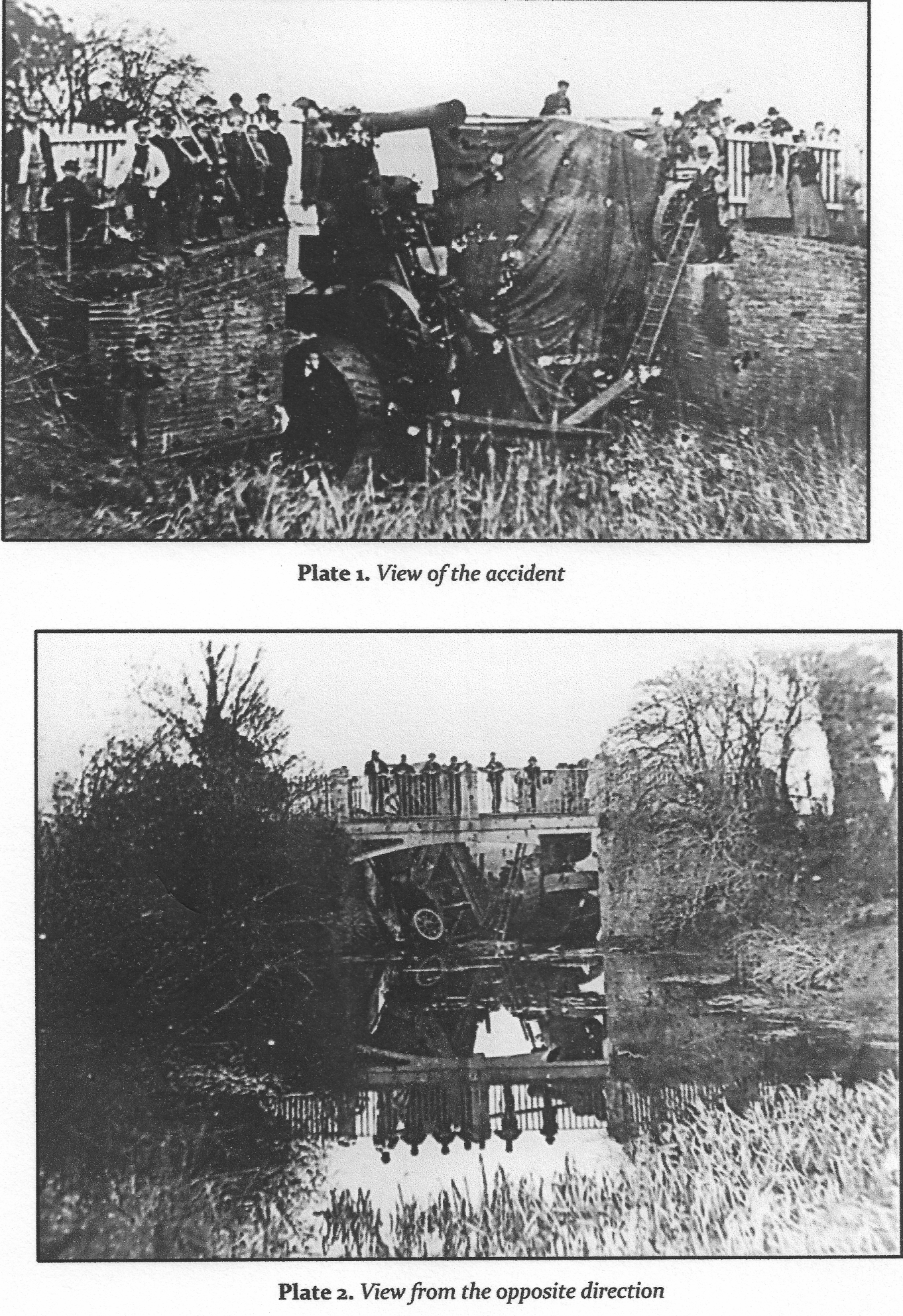
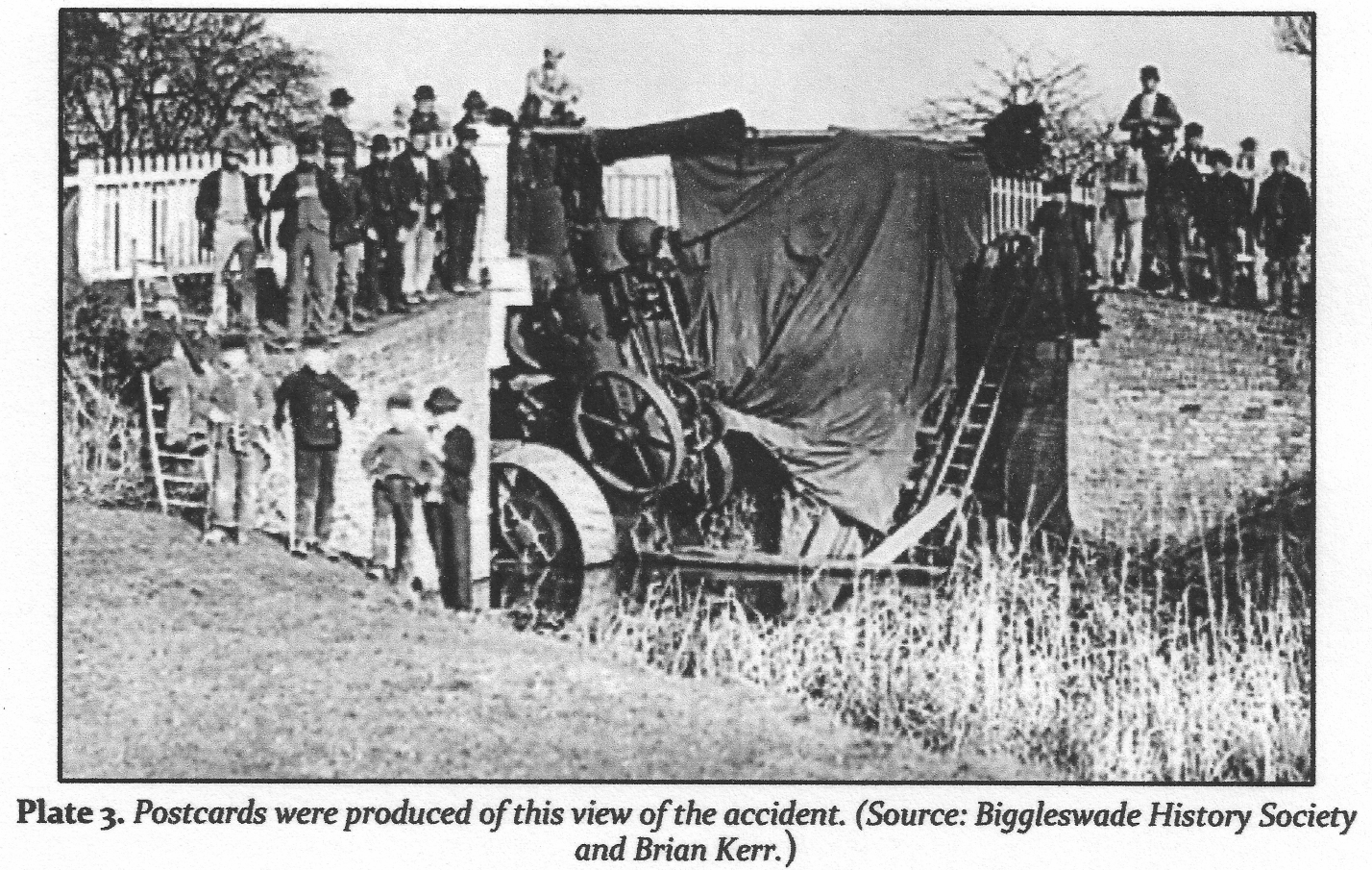 The team riding on the engine were thrown off: whilst Yerrall escaped injury, the two men were less fortunate – David Larman suffered serious head wounds and Walter Bonas was trapped underneath with part of his body out of the water, but the tangled machinery and a portion of the broken girder were on his left leg. As soon as possible, help was sought from Broom and Biggleswade – with a builder, carpenter, and a Biggleswade agricultural machinist plus police officers arriving, followed by two surgeons from Biggleswade as well as another from Girtford. David Larman was taken to his home, where he received medical treatment. But despite every effort being made to extricate 30-year-old Walter Bonas, who, in agony, was able to talk and declined amputation, he sadly died some two hours later. It did not prove possible to free Mr Bonas until the following morning (Wednesday, 12 February) whence his body was conveyed to the Black Horse, a small beerhouse nearby, where an external examination was undertaken by Mr Stevens, one of the Biggleswade surgeons who had been present the previous afternoon. As the photographs above also demonstrate, a number of onlookers visited the scene of the accident (apparently reaching into the hundreds, according to a local newspaper report, with some wanting to see the body at the Black Horse).
The inquest
The inquest into the circumstances surrounding the death of Mr Bonas (who left a wife and two children) was opened on the afternoon of Friday, 14 February by Mark Whyley, coroner for the county, and resumed on Friday, 21 February.
Mr. T W Pearse, clerk of the peace for the county, attended to watch the proceedings on behalf of the justices and County Surveyor, Mr. James Horsford. (As explained below, part of the role of the legally qualified county clerk was to advise justices of the peace in both their judicial function and their administrative responsibilities which included some bridges.)
Bedfordshire Times and Independent reported that Colonel William Yolland, who had inspected the scene of the accident on the morning of 21 February by order of the Board of Trade and at the request of the Secretary of State (with whom the coroner had communicated), gave evidence. He stated that
as the greater portion of the girders were still in the water he had been unable to inspect them to ascertain their strength and defects, but he should say that the bridge was never intended to carry such a heavy weight as a traction engine. He had no hesitation in saying that the weight on the after wheels was the cause of the fracture, there having been about 8 tons over the two girders, supposing the engine was in the centre of the road the time. The outside girders were much stronger than the others, but the whole structure was very slight.
County surveyor, James Horsford, who had been present at the scene early on the morning following the accident gave evidence that ‘when he inspected the bridge at Christmas it appeared all right, and he had had it repaired several times’. James Finding testified that ‘when he repaired it he found crack in one of the girders, which hung down an inch and he put his rule into the fissure’. In her History of Bedfordshire, Joyce Godber indicates ‘there was a known crack in one girder’ suggesting
This may have been the result of the canal freezing in 1823 when it was in transit; the forwarding agents disclaimed responsibility; and as it was an outside girder, and normal traffic over the bridge at that time was not heavy, it was thought this would not matter.
The inquest jury returned a verdict of ‘Accidental death’, but added the opinion that other bridges in the neighbourhood were also insecure. Colonel Yolland said that probably a circular would be issued by the Board of Trade giving a general caution to the authorities with respect to such bridges, and recommending that they be tested before being crossed by such heavy weights.
Paying for repair/replacement of the bridge
Before turning to the considerable court proceedings that followed the inquest concerning who was responsible for repairing/replacing the bridge, a bit of context about the role of the justices of the peace; what is known about the bridge; and about the steam-ploughing engine:
Bedfordshire bridges – the role of the county administration at the time
Justices of the peace carried the main weight of county administration and the supervision of hundreds and parishes. They held sessions quarterly each year and their chief paid officer was the clerk of the peace (the Pearse family held the office for nearly a century: Theed Pearse senior from 1798–1843, his son Theed William Pearse serving from 1857–1890). The clerk’s duties also involved Quarter Sessions record-keeping and the drafting of indictments and presentments (the statement presented when a matter to be dealt with was formally referred to an authority for consideration). Quarter Sessions served two functions – both administrative and as a court of justice. At Quarter Sessions the justices’ administrative responsibilities were very minor compared with county/unitary authority administration today. Not all bridges came within their sphere – but the justices themselves supervised local contractors for repairs for those that did; they also authorised parish highway rates; and had various other powers and duties.
Initially in rural areas, bridges were often the sole responsibility of the local lord of the manor, although in some places, bridges were maintained by the parish as a whole, rather than by the lord of the manor as an individual. In some cases, there was a complex arrangement of shared liability, in addition, monastic houses were frequently involved in bridge-building and repair.
Under Henry VIII, legislation was introduced which not only reaffirmed existing customs, but also for the first time required justices of the peace to raise a county rate for the repair of those bridges outside towns where no authority or individual could be proven to be responsible. Ecclesiastical liability for bridges was removed after the Dissolution of the Monasteries – the repair liabilities were not transferred to the new landowners and subsequently fell to the justices of the peace for the county.
Until the end of the 18th century, the county bore responsibility (in whole or part) only for the great bridges of St Neots, Barford, Bromham, Stafford and Harrold. By this time more and more bridges were being built through private funds, by turnpike trusts, parishes or individuals. Their builders frequently failed to maintain them, and the county was found responsible for ever-increasing numbers of bridges. This problem was addressed to some extent in 1803, when an Act of Parliament required that new, privately built, bridges should be constructed in a manner of which the justices would approve, before the county could take over responsibility for repair.
Most of Bedfordshire’s early iron bridges were extremely simple. They were invariably of single span and basic in design. They relied on the principle of the timber beam rather than the stone arch, though the iron beams were slightly curved in order to distribute weight to the abutments.
The earliest was built at Langford in 1819, followed by Broom in 1822. Both of these were cast at Coalbrookdale in sections and transported by the Grand Junction Canal to Linford Wharf near Newport Pagnell, and thence by road to be assembled on site.
Throughout the 18th century individual justices supervised repairs of bridges for which they were responsible, often carried out by locally appointed caretakers. By 1816 the need for a full-time post was recognised and John Millington was appointed Surveyor of Bridges, and a separate committee was established to administer the surveyor’s work.
By 1849, the county accepted responsibility (in whole or part) for 39 bridges. The development of the Ivel Navigation and the Grand Junction Canal in the late 18th and early 19th centuries also saw the construction of several bridges, most of which remained the responsibility of the navigation and canal operators. Between 1868 and 1877 the turnpike trusts were wound up, and liability for their various bridges and culverts transferred to the county. From 1858 to 1874 Bedfordshire had two surveyors, one each for the north and south of the county. The justices usually ordered what they called a rate of 1/2d in the £.
Broom Bridge
A bridge known as Broom Bridge collapsed in about 1788 and was rebuilt in brick by the inhabitants of Broom in the parish of Southill. Bridges in Bedfordshire indicates that it was replaced in 1823 with an iron bridge designed by John Millington, the County Surveyor. Accounts surviving in the Quarter Sessions records show that the ironwork cost £13 per ton. Inclusive of screws, bolts and other wrought ironwork, the making of the drawings, and the expense of carriage from Coalbrookdale to Linford, the bill came to £156 16s 0d. The bridge itself weighed 12 ton, 1 cwt, 1 stone and 12 lbs (12.25 tonnes). A further £22 9s 10d was incurred in transporting the ironwork from Stanton Hill wharf (near Linford) to Broom. The bridge was a simple single span 20 feet wide. Millington’s drawing, dated September 1822 (Figure 2), shows it to have been formed by a series of iron girders resting on brick abutments. The braced girders supported a flat road surface, with two cut-outs in each spandrel. There was a low relief ‘keystone’ which projected below the ‘arch ring’. There were ornamental iron railings above, ending in square stone terminals. The design included stone pillars over the ‘keystones’ in the centre of the arch. Figure 2 can be compared with Plate 2, above.

Figure 2. Millington’s design for Broom Bridge (Source: Bridges in Bedfordshire.)
The ploughing engine
Between 1830 and 1850 there were numerous patents describing steam cultivating machinery. Initially these were horse-drawn portable engines, but from about the 1860s self-propelled steam engines started to be popularised. The engine involved in the accident was manufactured by the John Fowler company at the Steam Plough Works in Leeds. Records held by the Steam Plough Club indicate the engine involved was one of the pair of John Fowler, 10 horse-power, single cylinder, horizontal shaft, ploughing engines, numbers 1074 and 1076, completed on 30 September 1868 and delivered new to Thomas Kitchener at Potton, Bedfordshire.
T B Kitchener & Co. of Potton was the largest operator of steam engines hired out to local farmers in east Bedfordshire – the firm had traction engines, ploughing engines, and a steam roller, using their own foundry and works to repair and maintain a whole range of equipment including threshing tackle, ploughs, cultivators, harrows, mole drainers, clover hullers and pond dredgers.
Plate 4 shows a Fowler-built horizontal shaft engine of a similar vintage. Ploughing engines were specifically built to do cable work – the winding drum having some 450 yards of wire rope, this being clearly visible beneath the boiler drum. This was accomplished by having a pair of engines – one either side of the field – with their respective cables connected to the plough or cultivator which was to do the work. Very simply, they took turns to pull in their cable thereby drawing the implement from one side of the field to the other. At the end of each run (bout) the implement was either ‘tipped’ (as in the plough) or ‘turned’ (as in the cultivator) so it could return to the other side doing its work.

Plate 4. A Fowler-built horizontal shaft engine similar to that involved in the accident. (Source: Steam Plough Club.)
In the case of the engine involved in the accident, the power to drive the winch drum was via a horizontal-shaft, through bevel gears down a vertical shaft to the drum gears. This horizontal-shaft was a feature of late 1860s design but was later superseded by a drive system directly under the crankshaft which did away with the need for it. It was not unusual for such ploughing engines to be used for more general purpose duties like towing the Threshing Set and then driving it via a belt on the flywheel. It would have been a far less onerous job than ploughing or cultivating and far cheaper for the owner unless he had other traction engines.
Court proceedings
On 29 July 1873, the Bedfordshire Times and Independent reported on the assizes trial of Thomas Benbow Kitchener, who had been on bail
for breaking down the bridge near Holme Mill, crossing stream called Rook’s hole, in the parish of Southill, causing a traction engine to go upon it, on February 11, whereby the traffic was stopped.
He pleaded Not Guilty. The lawyer prosecuting for the county justices opened the case by citing from the statute ‘making liable any person who caused damage to any bridge on a public highway whereby the traffic was impeded’; arguing that the bridge was strong enough to carry most ordinary traffic, like most other bridges, ‘but when any person chose to run the risk of conveying locomotives over them he became liable for the damage which might ensue”’
The defence lawyer contended that there had been a defect in the bridge several years before, and this ought to have been repaired unless notices were posted to stop the traffic, which had not been done; he had evidence to show the bad state of the bridge, and that there was no negligence on the part of the driver; and further suggested that the Act never contemplated the total breaking down of a bridge, but merely repairs. In response to the Judge saying that ordinary traffic did not include traction engines, the defence lawyer replied that surely in the year 1873 traction engines were so included.
In his evidence, James Horsford said that he had been County Surveyor for the northern division for the previous 15 years during which time the bridge had been repeatedly repaired under his direction and the cost charged upon the county rates. He clarified that it consisted of iron girders lying on brickwork, and that he had ordered repairs to the iron fencing and brickwork, but not to the girders. The iron plate bolted on in repair had been put on before he was appointed. Although a mason employed to repair the bridge two years before the accident had drawn his attention to a crack considered unimportant, the surveyor averred that it was not in consequence of the defect in the girder or spandril that the bridge broke down. At the beginning of this year it had been strong enough to bear any ordinary traffic. However, when he saw it on 12 February, the day after the accident, one girder alone remained out of the five; he expected that the girders ran deeper than they did; and whilst many of the bolts were gone they did not affect the strength of the bridge, being only connected with that part where the gravel was laid over. The engine with the machine stood on end side by side, and the traffic was altogether suspended.
He confirmed that the traction engine was marked 10 tons as the weight without water or coals or the drum; the water and coals would have been about 2 tons. Mr Horsford said the second time he went, he saw Mr Kitchener there giving orders respecting its removal. The bridge remained in the same condition at the time of the trial, but the county had put up a temporary bridge for the convenience of the public. The surveyor said that he had not been asked the question at the coroner’s inquiry, but he was never aware that a traction engine ever crossed the bridge or he would have said it would not have been strong enough. He was now aware that, by putting up a notice, persons can be prohibited from taking such engines over and confirmed to the Judge that such notices had now been put up on other similar bridges.
After hearing further evidence, the Judge was of opinion that the case for the prosecution was made out – those who took locomotives across bridges did so at their own risk as they were not included in ordinary traffic, and the authorities were not bound to give notice that the traffic was not to include traction engines. But he said that he could refer these various points before the Court for Consideration of Crown Cases Reserved for judgment.1 (Under the legal system in place at that time, after a conviction, the trial judge in a criminal case had discretion to refer an appeal on a point of law to the Court for Consideration of Crown Cases Reserved, where it would be heard by at least five judges including at least one Chief Justice or Chief Baron. This court could only hear appeals on a point of law; it could quash a conviction, but not order a retrial or alter a sentence.)
The lawyers for both sides then put forward arguments as to how much Mr Kitchener should have to pay towards the re-erection of the bridge, if the reserved matters be decided in favour of the county; and, conversely, whether he would be entitled to something for the repair of the engine and machinery in the event that the case was determined in his favour. The judge said that it was advisable that some sum should be agreed and suggested that £150 should be named by the parties.
As there was no agreement, the judge told the jury that the prosecution were legally right, and as the facts were clear a verdict of Guilty must be returned. But, after having consulted for some minutes, the jury told the judge that they found a verdict of Guilty, but they thought Mr Kitchener ought not to pay more than the value of the old bridge, which could easily be assessed by the County Surveyor. The Judge then confirmed that subject to the points reserved, the defendant, Mr Kitchener, had been convicted – he was bound over in the sum of £150 to appear at the next Assizes to receive judgment if called upon.
However, the Court for Consideration of Crown Cases Reserved unanimously found in favour of Mr Kitchener and quashed the decision given at the Assizes.
On 10 January 1874, the Bedfordshire Mercury reported on the local justices’ response to the decision of the appellate court. At an initial committee meeting, the Clerk of the Peace read the justices the case stated by Mr Baron Cleasby in Regina v Kitchener and the decision. The committee chairman commented that he was
very sorry that this case should have been decided in the way it has by the Court for the Consideration of Crown Cases Reserved, for it seems to me that are now at the mercy of anybody who likes to come over our bridges with an engine of any weight; and there is no appeal . . . the best thing we can do is to accept the situation.
It was observed that although a temporary bridge had been put up, no other action had been possible until the case had been decided but now must be taken urgently. The committee agreed that the bridge would need to be replaced and any other such bridges be strengthened in such a way as to avoid a repetition of the accident. The chairman pointed out that the court could not order the widening of any bridge without making a presentment to the grand jury. It was suggested that if the report were adopted at once, the jury would authorise the expenditure of £1,000 but not specify what bridges were to be done and that the money could be borrowed from the Public Works Loan Commissioners, to be repaid in 14 years.
The following day, the court assembled and the grand jury was sworn in. The chairman said that after the grand jury had done all the criminal business, the justices would send up a formal presentment to enable the magistrates to strengthen certain county bridges, which they could not do without the permission of the grand jury. He told them that the Court for the Consideration of Crown Cases Reserved had quashed the decision given at the Assizes on the accident at Broom Bridge. Previously, because the Assizes Judge had determined that the person who broke the bridge was liable for the repair of the bridge and as magistrates generally thought this was the situation, it had been the magistrates’ duty to exhaust every legal means to try to compel the engine owner to pay, and it would have been illegal for the county to have expended any money upon it till the point was settled. But, he explained, it was now the duty of the county to strengthen all these bridges because the court above had quashed that decision.
Accordingly, there was a certain number of the county bridges which a committee of the justices considered should be repaired at once. The grand jury would be sent a list, they would have the evidence of the County Surveyor, and the committee could also give evidence. The chairman also reminded them that if the grand jury did not find the presentment, the county risked being put to a very much greater expense if any bridge failed before it was strengthened – but assured them that apart from Broom, there was only one bridge which was very bad, and that would have required a large expenditure to put it in repair even for ordinary traffic.
The court ordered a 1d rate after the grand jury formally heard the presentment urging the strengthening of certain named bridges that were insufficient for the traffic (doubling the usual rate).
Afterwards
The implications for the county’s bridges were quite significant. Inspections were widely undertaken, especially to bridges of similar construction. For example:
– Three additional wrought-iron, solid-flange girders were fixed to Langford Bridge to lend support to the iron plates of the deck (when the bridge was taken down in 1946, the abutments showed evidence of widening which may also have been part of the work carried out at the same time).
– at Clay Bridge, which crossed the River Ivel north-west of Clifton, it was noted that the iron girders had been cast in two pieces and joined in the centre, causing vibrations when carts passed over, also the centre girder had been repaired and the bridge could only support a 7 ton (7.1 tonnes) weight. The report recommended inserting six new iron trellis girders to reinforce the outer part of the old girders and the iron plates that support the road – at a cost of £135.
– detailed surveys were carried out on both Shefford’s north and south bridges and the plans for strengthening the north bridge in 1873 have been preserved.
From 1858 to 1874 Bedfordshire had two surveyors, one each for the north and south of the county. But, in 1874, William Wallace was appointed surveyor for the whole county with a salary of £200 pa.
The Steam Plough Club archives reveal that both engines survived in Mr Kitchener’s ownership through to 1921 when they acquired the road registration identities of NM 196 and NM 197. Clearly, the engine that fell through the bridge was repaired and had a long life. When T B Kitchener & Co was sold in 1927, they had 27 steam engines, a living van and water cart, plus a large range of other agricultural machinery.
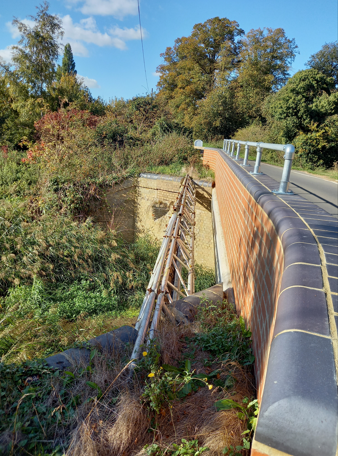
Plate 5. The bridge today.
Note
1. The Court for Crown Cases Reserved was created by the Crown Cases Act 1848 for criminal cases in England and Wales for appeal only on a point of law. It was superseded in 1907 by the Court of Criminal Appeal which became the Criminal Division of the Court of Appeal in 1966.
References
Bedfordshire Mercury, Saturday, 10 January 1874.
Bedfordshire Mercury, Saturday, 10 January 1874.
Bedfordshire Times and Independent, Tuesday, 18 February 1873.
Bedfordshire Times and Independent, Tuesday, 29 July 1873.
Godber, Joyce: History of Bedfordshire 1066–1888 (Bedfordshire County Council, 1969).
Ordnance Survey map extracts – National Library of Scotland:
-
Ordnance Survey One-Inch, England and Wales, Engraved Maps 1872–1914 (Sheet 204 – Biggleswade; surveyed 1876–1886, Revised 1893, Published 1896)
-
Ordnance Survey Six-Inch, England and Wales (Bedfordshire Sheet XVIII.SW; surveyed 1881–1882, Published 1884)
-
Ordnance Survey Six-Inch, England and Wales (Bedfordshire Sheet XVIII.NW; surveyed 1881, Published 1886)
Page, Ken: ‘Steam on Road and Field in East Beds’, History in Bedfordshire, Vol 1, No 5 (January 1994).
Simco, Angela & McKeague, Peter: Bridges of Bedfordshire (Bedfordshire Archaeology Occasional Monograph Series, No 2, 1997).
Acknowledgements
I am grateful to Dick Eastwood of the Steam Plough Club for assistance in preparation of this piece; also to Brian Kerr and Biggleswade History Society for providing archive photographs.
Compiled by ANN CURRELL 2023