The Saxon Coin Hoard Find in Langford
The Saxon Coin Hoard Find in Langford
Imagine finding buried treasure! Not on a desert, pirate, island but in Langford! Metal detecting is a hobby which can turn up some interesting finds. This requires the landowner’s permission and any significant or potentially valuable finds must be declared and reported. Under the stipulations of the Treasure Act 1996 the Langford hoard qualified as Treasure.
In 2016 a slightly dispersed, but closely grouped, hoard of 20 early medieval silver coins dating c AD 880–923 were found to the west of the River Ivel in the parish of Langford. Subsequently these coins were examined by the British Museum. Examination, storage and conservation has taken until 2021.
Were they dropped and lost or were they buried for safe keeping but never retrieved?

All of the coins are variants of the type introduced by Alfred of Wessex (871–899) about 879–880. Coins were issued in the name of Alfred himself, and, following a tradition dating back to the 8th century, Plegmund, Archbishop of Canterbury (890–923) who was originally from Mercia and first chosen by Alfred to translate Latin texts before his selection as Archbishop. Of the coins in Alfred’s name, some also carry the inscription DORO, short for Dorovernia (Canterbury). Of the 19 coins with legible inscriptions, there are five decipherable coins in the name of Archbishop Plegmund, and nine in the name of Alfred with a Canterbury mint signature. 75% of the coins in the hoard were minted in Canterbury. This strongly suggests that the hoard probably came from Kent, perhaps the property of a merchant.
The location of the hoard is interesting, given its date and character. A surviving treaty between Alfred and Guthrum, the Viking ruler of East Anglia, set the boundary between their respective territories. The treaty was probably agreed between c 879 and the death of Guthrum in 890. The coins of Plegmund provide an earliest possible date of 890 for the hoard, which thus probably postdates the death of Guthrum, However, there is no evidence to suggest that the political situation changed radically following the death of Guthrum, with East Anglia retaining its independence, apparently still under rulers of Viking origins. The treaty may thus still have been current at the time that the hoard was lost or deposited. The treaty specifies that the boundary runs up on the Thames, and then up on the Lea unto its source near Leagrave, then straight to Bedford, then up the Ouse to Watling Street. This would place the location of the hoard in Viking territory rather than Alfred’s (although quite close to the border). The hoard is predominantly Anglo-Saxon rather than Viking. The treaty makes explicit reference to trade across the border between the two kingdoms, and this may explain the presence of a hoard of Anglo-Saxon character on the Viking side of the border at this time.
The coins contain at least 10% precious metal. None of the coins in the hoard have the visible ‘peck’ marks characteristic of coins which have passed through Viking hands, indicating that they have been tested with knives to establish that they were good silver. However, the coins have not yet been fully conserved, and it is possible that peck marks may be currently be hidden beneath surface corrosion on some of the coins. Three examples from the 20 coins recovered are shown below.
Guthrum was King of East Anglia in the late 9th century. Originally a native of what is now Denmark, he was one of the leaders of the Great Summer Army that arrived in Reading during April 871 to join forces with the Great Heathen Army, whose intentions were to conquer the kingdoms of Anglo-Saxon England. The combined armies were successful in conquering the kingdoms of East Anglia, Mercia and Northumbria, and overran Alfred the Great’s Wessex, but were ultimately defeated by Alfred at the Battle of Edington in 878. The Danes retreated to their stronghold, where Alfred laid siege and eventually Guthrum surrendered.
Under the terms of his surrender, Guthrum was obliged to be baptised as a Christian and then leave Wessex. The subsequent Treaty of Alfred and Guthrum set out the boundaries between Alfred and Guthrum’s territories, as well as agreements on peaceful trade. This treaty is seen as the foundation of the Danelaw. Guthrum ruled East Anglia under his baptismal name of Athelstan until his death.
Athelstan was also the name of the son of King Edward the Elder and his first wife, Ecgwynn. Modern historians regard him as the first King of England (reigned 924–939) and one of the ‘greatest Anglo-Saxon kings’. He never married and had no children. He was succeeded by his half-brother, Edmund I (939–946).
For further information on these items visit the Portable Antiquities Scheme on the internet. The record for the hoard is now publicly available at: https://finds.org.uk/database/artefacts/record/id/803144
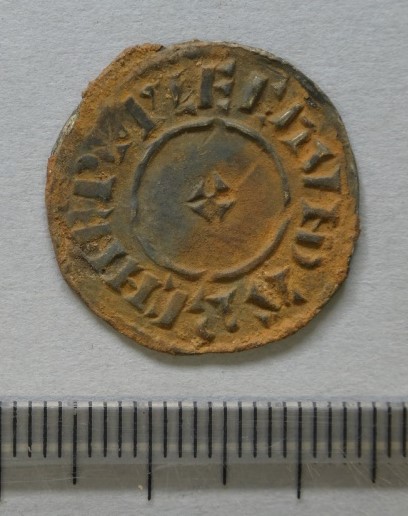
Above image of a penny of Plegmund, Archbishop of Canterbury, AD 890–923.
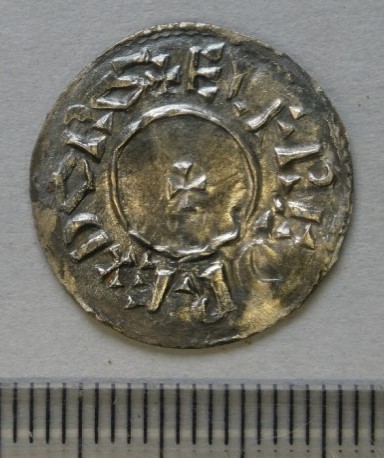
Above image of the obverse side of a silver penny of Alfred (AD 871–899).
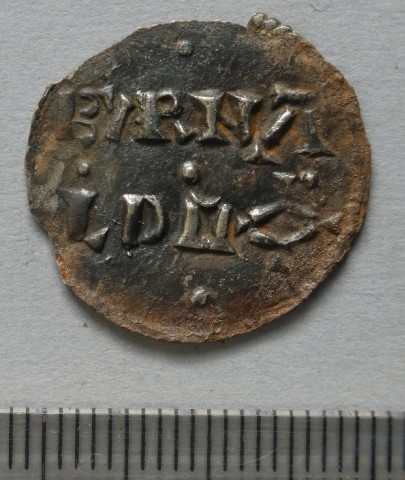
Above image of a silver penny of Alfred (AD 871–899).
Information supplied by Central Bedfordshire Council Portable Antiquities Scheme and Wikipedia. Images courtesy of The Higgins Art Gallery and Museum, Bedford.
Compiled by John Shipman